broxy: Central MCP Gateway for Managing Multiple Agent Toolsets
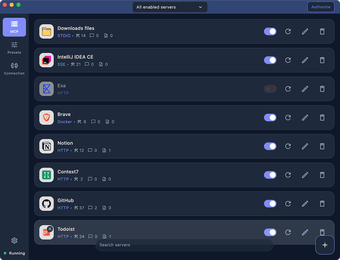
broxy, from Qent, is a gateway for the Model Context Protocol that aggregates multiple MCP servers into a single endpoint for AI agents. It filters tool exposure with task-specific presets, bridges local STDIO servers to cloud clients, and supports STDIO, HTTP, SSE and WebSocket transports to reduce context noise and token usage. Built in Kotlin to run locally, it offers hot reloading, dynamic OAuth registration, and customizable icons for managing many tools. Developers and power users gain centralized, secure control of MCP toolsets.
Aggregates disparate MCP services so clients see one operational endpoint
broxy fronts multiple upstream MCP servers as a unified endpoint, which removes the need to register each server separately in every AI client. Preset-based filtering narrows which tools, prompts, and resources are exposed for a specific task, reducing unnecessary context sent to agents. Teams that maintain many small services benefit from consistent naming and a single access point for agent orchestration.
Bridges varied transports so tools using different protocols can interoperate
The gateway handles STDIO, HTTP, SSE, and WebSocket transports, making protocol differences transparent to the client. That protocol bridging lets local STDIO servers and HTTP endpoints appear under the same MCP facade, enabling mixed implementations to cooperate without bespoke adapters. This reduces the manual work of combining capabilities from several upstream servers when composing agent toolsets.
Runtime features favor developer workflows but imply local administration
Implemented in Kotlin to run locally, broxy supports hot reloading so presets and mappings change without restarting the service, which suits continuous development and rapid iteration. Dynamic OAuth registration automates client onboarding for servers requiring authenticated access, and readable naming helps manage long lists of tools. These choices require operators to manage local deployments and configuration governance as part of the workflow.
Security and exposure depend on how you deploy and configure OAuth
Broxy can bridge private local tools to cloud assistants over secure connections, and it discovers OAuth metadata to register clients automatically when needed. Because the application runs on a host you control, administrators retain local file and network boundaries. The project is actively maintained within the MCP community, which supports ongoing fixes and template updates for operational deployments.
Best for teams with operations capacity; not aimed at casual end users
broxy is a practical gateway for developers and teams that operate multiple agent tools and accept local deployment responsibilities. It suits environments where configuration discipline, OAuth governance, and preset lifecycle management are established. Teams without that operational capacity should expect a learning curve and plan governance for exposed tools and OAuth scopes before using broxy in production workflows.
Pros
Consolidates multiple MCP servers behind one endpoint, reducing per-client configuration
Preset filtering limits tools sent to agents, cutting context noise and token use
Supports STDIO, HTTP, SSE, and WebSocket transports for mixed-protocol toolsets
Hot reloading plus dynamic OAuth registration eases runtime updates and onboarding
Cons
Requires MCP-compatible clients; not useful outside the MCP ecosystem
Local deployment needs ongoing administration and MCP workflow knowledge
OAuth automation requires careful scope and credential management
Laws concerning the use of this software vary from country to country. We do not encourage or condone the use of this program if it is in violation of these laws. Softonic may receive a referral fee if you click or buy any of the products featured here.